
.jpg)

Rebecca Brown
Companies using natural gas in their operations, especially those that use substantial thermal energy, can utilize renewable thermal certificates (RTCs) to mitigate their Scope 1 greenhouse gas emissions.
RTCs are a type of transactable instrument called an environmental attribute certificate (EAC) that is separated from the physical commodity, representing the environmental benefits associated with renewable natural gas (RNG). RTCs can be used as a tool for decarbonization for organizations looking to lower their overall greenhouse gas emissions.
A single RTC represents the environmental attributes of one dekatherm of RNG injected into the natural gas pipeline system. When paired with natural gas combustion, RTCs allow businesses to reduce their carbon footprint without needing to make costly changes to their infrastructure or disrupting existing operations.
As global efforts to reduce greenhouse gas emissions ramp up, RTCs are increasingly becoming a trusted and accessible tool for meeting regulatory mandates and sustainability goals. This growing demand is accelerating expansion of the global RTC market, which is forecast to reach $4.5 billion by 2033, from $1.2 billion in 2024, a compound annual growth rate of 15.2%, according to Market Intelo.
Here’s a more in-depth look at how RTCs work, their benefits, possible challenges, and how to get started using them.
What Are RTCs and How Do They Work?
RTCs are derived from RNG, a biogenic alternative to fossil-based natural gas. RNG has a significantly lower carbon intensity than traditional natural gas because it’s produced by capturing and purifying methane emitted by decomposing organic waste from landfills, wastewater treatment plants, or livestock farms.
It’s a drop-in fuel, meaning that once it’s produced, it can be injected into natural gas pipeline systems without the need to change the existing infrastructure.
When RNG is injected into gas pipelines, the environmental attribute is separated from the physical gas and tracked as an RTC. The set up is similar to how the environmental attributes of renewable electricity are tracked and delivered through the use of renewable energy certificates (RECs).
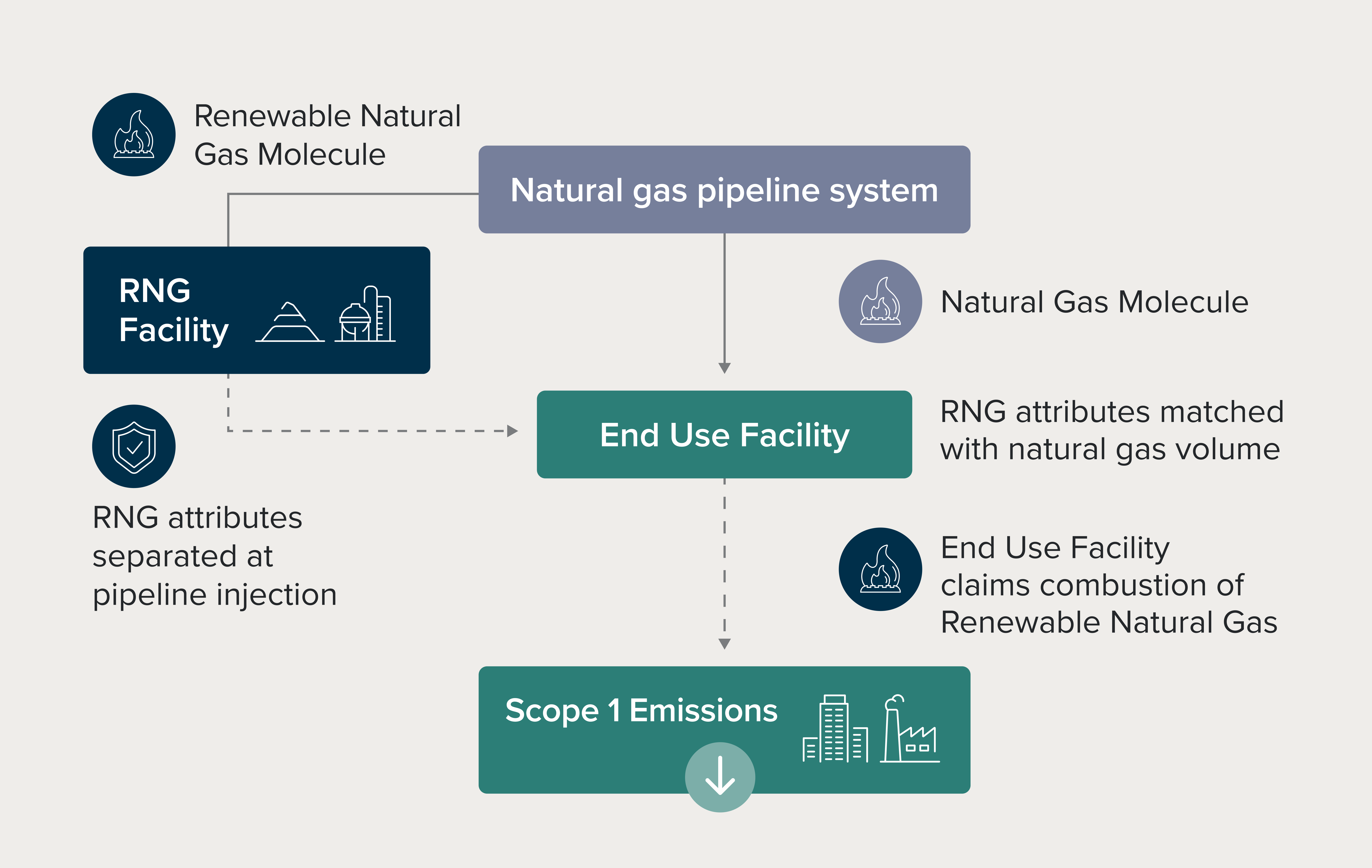
RTCs are certified, tracked, and delivered through third-party registry platforms such as CleanCounts (formerly known as M-RETS) that manage the activity of EACs and other environmental commodities. Registries such as CleanCounts prevent double counting and ensure that the value chain associated with purchasing an RTC is transparent. Each RTC generated includes a project ID, location, the year and month of production, as well as a unique identifier for each dekatherm of RNG.
When a buyer wants to take claim of the environmental benefits associated with RTCs, they can retire the certificates, permanently removing them from circulation.
Advantages of RTC
RTCs have a number of advantages:
- They directly mitigate Scope 1 emissions, similar to how RECs address Scope 2 emissions.
- They are listed on the CleanCounts and other third-party registries and can be matched with fossil natural gas, reducing emissions without changing operations or infrastructure.
- They don’t expire and through the interoperable nature of the North American gas grid, are fungible for any pipeline connected facility across the continent. Any one RTC can substitute for another with no change to the underlying Scope 1 claim, with each RTC directly displacing 1 dekatherm (Dth) of fossil natural gas.
- They allow a business to decarbonize while simultaneously supporting the capture of methane emissions and furthering the development of the RNG market by providing demand signals for RNG projects that may not have the scale or configuration to qualify for other federal or state level incentives.
Accounting and Other Challenges
Several challenges exist that are potential barriers to adopting RTCs.
Evolving accounting practices. The biggest challenge is still‑evolving emissions‑accounting practices. The global Greenhouse Gas Protocol, which sets standards for measuring and reporting Scopes 1, 2, and 3 emissions, does not provide definitive guidance on the use of market-based instruments such as RTCs for Scope 1 emissions—but it also does not explicitly exclude them. In its interim guidance, the Protocol notes that, “In the absence of guidance, companies purchasing certificates may wish to consult with their auditors and consider rules provided by relevant target‑setting programs or applicable regulatory schemes in their jurisdiction(s) on how to report these purchases in their reports, while ensuring full transparency and following all GHG accounting and reporting principles.” As a result, many buyers are increasingly working with their auditors to establish defensible reporting approaches.
At the same time, both the GHG Protocol and the Science Based Targets initiative (SBTi) are actively evaluating how market‑based instruments—including RTCs—could be applied in Scope 1 accounting frameworks. This review is part of a broader shift toward enabling market‑based treatment of low‑carbon fuels: for example, the Center for Resource Solutions (CRS) released its Market‑Based Accounting for Clean Fuels guidance last year, outlining conditions under which RTCs can be used within defined system boundaries. In addition, the GHG Protocol’s Phase 1 Progress Update (December 2025) proposed creating a “Contractual GHG Inventory” to account for certificates associated with low‑carbon fuels and commodities—similar in concept to the market‑based and location‑based split used in Scope 2.
Meanwhile, some Fortune 500 companies and utilities have reported using RTCs and receiving clean audits, and major accounting and certification firms have signed off on treating RTCs as biogenic emission instruments. In 2025, hundreds of companies also signed a joint letter urging the GHG Protocol to formally recognize RTCs and other market‑based instruments for low‑carbon gases within Scope 1 inventories.
Supplies
In addition to evolving accounting practices, procuring RNG is more expensive than natural gas because of both the cost to produce and incentives available for the RNG. RNG production in 2026 is also only a small percentage of overall natural gas production. As a result, companies interested in utilizing RTCs as a decarbonization tool may want to evaluate long-term structures to manage costs and ensure long-term availability.
How Anew Climate Can Help
Anew is one of North America’s leading independent RNG marketers, connecting producers with buyers seeking clean energy. As one of the industry’s earliest and most active participants, Anew has built a diverse portfolio of high-quality suppliers, including multiple ultra-low carbon intensity producing partners.
Anew offers:
- Verified RTCs through the CleanCounts registry
- Turnkey solutions tailored to a company’s energy profile
- Cost-effective access to renewable fuel attributes, including aggregating demand across multiple projects and offering flexible supply structures
- Milestone Scope 1 goal support
If natural gas is part of your energy equation, RTCs can help meet your decarbonization targets. Learn more here, or contact our RNG team today.